


Decode Immune Resilience
Uncover the biological imprint of your past and the real-time effects of your current routines and practices
SapereX Longevity is a blood test that provides high-resolution immune resilience and cellular senescence measurements, designed to help longevity and concierge clinicians understand biological status today and track meaningful change over time
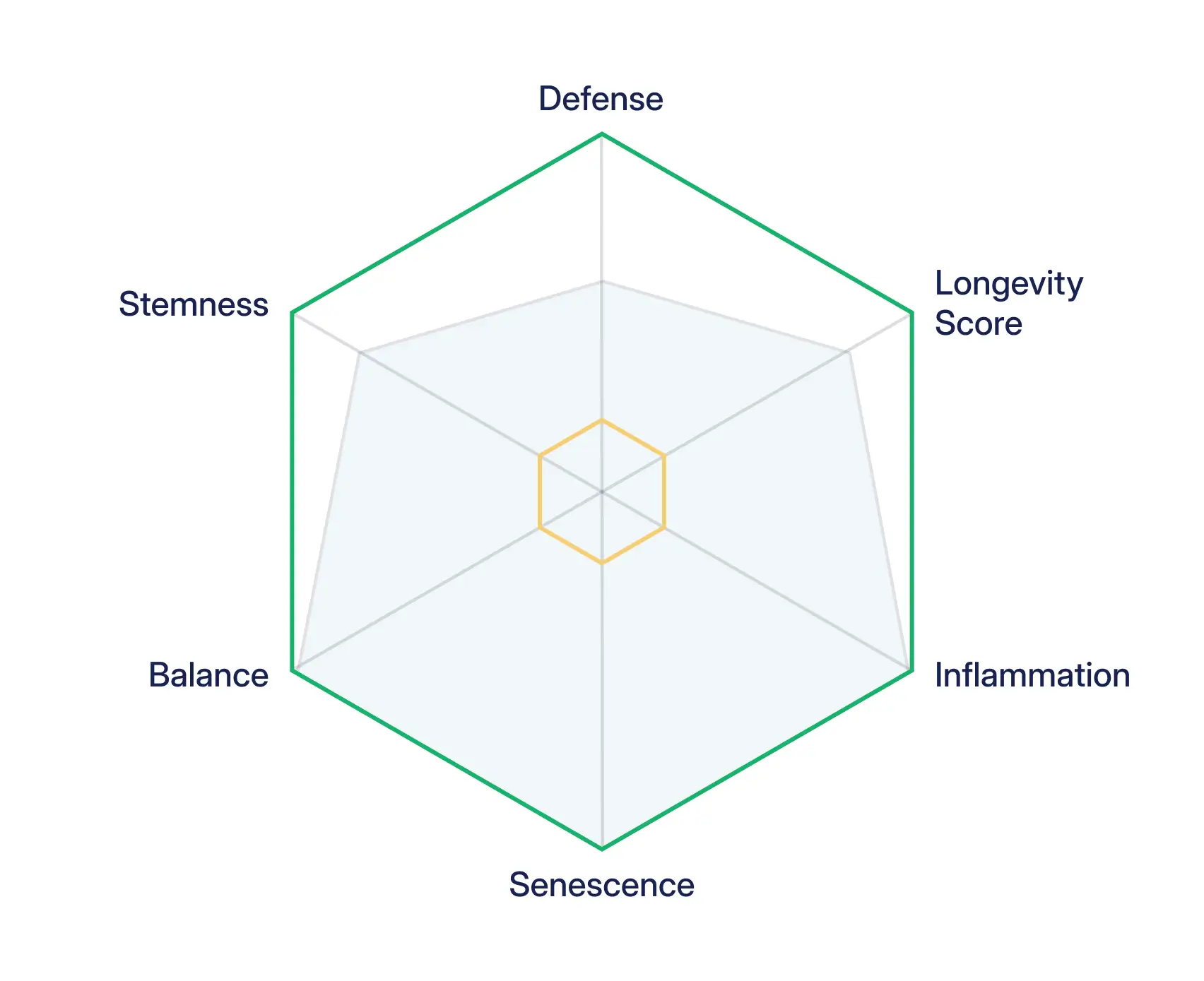
What SapereX Longevity Measures
Defense
A measure of the strength of your immune system to defend against infections. When T cells, the immune system's fighter cells, battle infections or diseases for too long, they get worn out and stop working properly. Scientists refer to this as T cell exhaustion.
stemness
Good capacity of stem T cells to respond to challenges.
Balance
Well balanced ability of T cells to respond and return to baseline.
SENESCENCE
Very low senescent cell load suggests excellent aging trajectory.
INFLAMMATION
No molecular signs of chronic inflammation.
LONGEVITY SCORE
Good ability to resist infections, suppress inflammation and remove senescent cells
Defense
Reduced ability of the immune system to respond to infections.
stemness
A measure of the amount of young (stem) cells that allow your immune system to respond to new challenges. When the body detects a threat, it can utilize stem cells or proliferate to quickly grow its T cell army. If this capacity is low, the immune system can't build enough reinforcements to fight effectively.
Balance
Well balanced ability of T cells to respond and return to baseline.
SENESCENCE
Very low senescent cell load suggests excellent aging trajectory.
INFLAMMATION
No molecular signs of chronic inflammation.
LONGEVITY SCORE
Good ability to resist infections, suppress inflammation and remove senescent cells
Defense
Reduced ability of the immune system to respond to infections.
stemness
Good capacity of stem T cells to respond to challenges.
Balance
An assessment of the balance between T cel proliferation and exhaustion. A balanced immune system can recognize threats quickly, respond effectively, clear out infections, and then return to a resilient, healthy state without over-reacting.
SENESCENCE
Very low senescent cell load suggests excellent aging trajectory.
INFLAMMATION
No molecular signs of chronic inflammation.
LONGEVITY SCORE
Good ability to resist infections, suppress inflammation and remove senescent cells
Defense
Reduced ability of the immune system to respond to infections.
stemness
Good capacity of stem T cells to respond to challenges.
Balance
Well balanced ability of T cells to respond and return to baseline.
SENESCENCE
A measure of a cellular state that causes whole-body aging. Senescent cells start to accumulate in early adulthood. Later, if unchecked, senescent cells can lead to organ dysfunction and give rise to diseases of aging such as heart disease, diabetes, and cognitive dysfunction
INFLAMMATION
No molecular signs of chronic inflammation.
LONGEVITY SCORE
Good ability to resist infections, suppress inflammation and remove senescent cells
Defense
Reduced ability of the immune system to respond to infections.
stemness
Good capacity of stem T cells to respond to challenges.
Balance
Well balanced ability of T cells to respond and return to baseline.
SENESCENCE
Very low senescent cell load suggests excellent aging trajectory.
INFLAMMATION
A measure of stress on the immune system by low-grade or chronic inflammation. Chronic inflammation promotes the release of chemical signals that keep your immune system on constant alert. T cells can become terminally differentiated and have altered autophagy, a self-cleaning process essential for their health.
LONGEVITY SCORE
Good ability to resist infections, suppress inflammation and remove senescent cells
Defense
Reduced ability of the immune system to respond to infections.
stemness
Good capacity of stem T cells to respond to challenges.
Balance
Well balanced ability of T cells to respond and return to baseline.
SENESCENCE
Very low senescent cell load suggests excellent aging trajectory.
INFLAMMATION
No molecular signs of chronic inflammation.
LONGEVITY SCORE
An assessment of the immune system's capacity to resist, recover, and stay well over time. A high immune longevity score (ILS) indicates resistance to infection and chronic inflammation, as well as an immune system capable of keeping senescent cells in check.
Defense
Reduced ability of the immune system to respond to infections.
stemness
Good capacity of stem T cells to respond to challenges.
Balance
Well balanced ability of T cells to respond and return to baseline.
SENESCENCE
Very low senescent cell load suggests excellent aging trajectory.
INFLAMMATION
No molecular signs of chronic inflammation.
LONGEVITY SCORE
Good ability to resist infections, suppress inflammation, and remove senescent cells.

Why Clinicians Use SapereX Longevity
Get Baseline Clarity
Establish a clear biological reference point for each client.

Track Interventions
Monitor biological response to lifestyle, nutritional, and clinical interventions over time.
Improve Engagement
Visual, contextual reporting helps clients understand and engage with their data.
Differentiate Your Practice
Offer advanced immune and aging- related diagnostics that extend your testing portfolio.
What the Experts are Saying
"We are trying to get an upgrade for our program on the pragmatism of the offerings we’re giving. Epigenetic-based tests are an attempt to try to get some kind of a number for people that they latch onto, but that we are looking for something that’s I think a little bit more applicable to initial measurement and serial follow-up. My whole approach has been to try have the patients come off of a single number, an absolute number. Current tests have just not been doing that for us."

"The way you break down the immune score and the immune aging I think is really helpful and it helps to explain other things that I’m seeing."
"This is really, really clinically resonating with me"
"In a field with dozens of tests and protocols and therapies, SapereX helps with keeping it realistic and understanding what is really making sense. The report is really helpful, not too much information, and presented nicely, with explanations specific to the client."
"You’ve got all these things out there, but it’s hard for a clinician to know because there’s such a paucity of human clinical data on efficacy and dosing, where to even start with this stuff. Your test helps me avoid reflexive longevity interventions when the patient’s immune profile does not support them: senolytics when senescence is already low, NAD/mitochondrial boosters when stemness is already high or out of balance, thymic/stem-cell-type interventions when proliferation is not the limiting problem."
"We are trying to get an upgrade for our program on the pragmatism of the offerings we’re giving. Epigenetic-based tests are an attempt to try to get some kind of a number for people that they latch onto, but that we are looking for something that’s I think a little bit more applicable to initial measurement and serial follow-up. My whole approach has been to try have the patients come off of a single number, an absolute number. Current tests have just not been doing that for us."
"The way you break down the immune score and the immune aging I think is really helpful and it helps to explain other things that I’m seeing."
"This is really, really clinically resonating with me"
"In a field with dozens of tests and protocols and therapies, SapereX helps with keeping it realistic and understanding what is really making sense. The report is really helpful, not too much information, and presented nicely, with explanations specific to the client."
"You’ve got all these things out there, but it’s hard for a clinician to know because there’s such a paucity of human clinical data on efficacy and dosing, where to even start with this stuff. Your test helps me avoid reflexive longevity interventions when the patient’s immune profile does not support them: senolytics when senescence is already low, NAD/mitochondrial boosters when stemness is already high or out of balance, thymic/stem-cell-type interventions when proliferation is not the limiting problem."
Case Studies
Immune resilience is shaped by many factors including exercise, nutrition, sleep, genetics, environmental exposures, recent and previous infections, and health practices. Because it’s shaped by so many inputs, it’s also one of the most dynamic and modifiable systems in your body.



From Order to Insight
SapereX Longevity is available to clinicians in the US, UK, and EU. Clinics pay for testing and bill clients directly.
Order test kits
Create a new clinic account and order through the portal. Kits can be shipped to the clinic or drop-shipped to a client
Collect blood
Requires standard venous blood draw. We're partnered with a nationwide mobile phlebotomy provider if an off-site draw is needed
Ship same day
Monday-Thursday to our in-house CLIA/CAP-accredited laboratory
Receive results
in 2-3 weeks
Re-test
in 3-4 months during optimization phases or annually for long-term tracking
Uncover resilience and personalize next steps

Deeper Conversation
Engage with Sapere Bio Scientific Experts
For clinicians who choose to engage more deeply, the Sapere Bio scientific leadership is accessible to support interpretation through shared reasoning, population-level context, and discussion of complex biological patterns. These conversations are not sales calls or treatment recommendations. They are peer-to-peer discussions to contextualize results.
"I thought it was going to be a sales call, but it ended up being more like a journal club"
"Will you be a guest at our Grand Rounds?"
Disclaimer: Sapere Bio does not provide treatment recommendations. Clinical decisions remain the responsibility of the ordering professional.


Peer-Reviewed Literature
- Mylonas A, O'Loghlen A. Cellular Senescence and Ageing: Mechanisms and Interventions. Front Aging. 2022;3.
- Baker DJ, Childs BG, Durik M, et al. Naturally occurring p16 Ink4a-positive cells shorten healthy lifespan. Nature. 2016;530(7589).
- McHugh D, Gil J. Senescence and aging: Causes, consequences, and therapeutic avenues. Journal of Cell Biology. 2017;217(1):65-77.
- Xu W, Larbi A. Markers of T cell senescence in humans. International Journal of Molecular Sciences. 2017;18(8):1-13.
- Yousefzadeh MJ, Flores RR, Zhu Y, et al. An aged immune system drives senescence and ageing of solid organs. Nature. 2021;594(7861):100-105.
- Chen HA, Ho YJ, Mezzadra R, et al. Senescence Rewires Microenvironment Sensing to Facilitate Antitumor Immunity. Cancer Discovery. 2023;13(2):432-453.
- Manoharan MS, Lee GC, Harper N, et al. The 15-Year Survival Advantage: Immune Resilience as a Salutogenic Force in Healthy Aging. Aging Cell.
- McLane LM, Abdel-Hakeem MS, Wherry EJ. CD8 T Cell Exhaustion During Chronic Viral Infection and Cancer. Annual Review of Immunology. 2019;37:457-495.
- Yi JS, Cox MA, Zajac AJ. T-cell exhaustion: characteristics, causes and conversion. Immunology. 2010;129(4):474.
- Chaudhary A, Leite M, Kulasekara BR, et al. Human Diversity in a Cell Surface Receptor that Inhibits Autophagy. Current Biolog! 2016;26(14):1791-1801.